
When you have grown up as an evangelical and are looking into Eastern Orthodoxy, icons are one of the first things that will cause immediate awkward feelings or worry. In Protestant churches, the walls are generally pretty bare. There may be a cross on the stage, some Scripture on banners, or painted on the walls. But this would be the extent of modern Protestant church religious decorations in most cases. Perhaps some older, more High-Church protestants have stained glass windows or something of that nature. Depictions of Jesus Christ, the Ever-Virgin Mary, and the Saints are not something to be found in Protestant churches. No doubt, the reason for this is that Protestants have feared breaking the Second Commandment regarding idolatry. That of making false images. But it is worth asking if these are indeed false images.
In the coming posts, I want to present three different arguments that will show that this is a critical error on the part of Protestants. These arguments convinced me that icons are Biblical and express the fullness of proper orthodox theology and the incarnational message of the Gospel. These arguments will take two paths, with the first one, I think, being more convincing to Protestants.
Why?
We will start with the Scriptures and use the Protestant shorter canon of scripture based on the Masoretic texts. Seeing the argument made from the shorter canon of Scripture I had as a Protestant was enough for me to realize that I was in error, and most Protestantism is in error on these points regarding icons. Since Protestants generally hold to Sola Scriptura (Scripture Alone), having Scripture itself bear witness to the correct nature of the Orthodox on icons is powerful.
The Argument From Scripture
Generally, the argument from the Protestants goes as follows:
God gave the Ten Commandments to Moses. The second commandment says:“You shall not make for yourself an idol, or any likeness of what is in heaven above or on the earth beneath, or in the water under the earth. You shall not worship them nor serve them; for I, the Lord your God, am a jealous God, inflicting the punishment of the fathers on the children, on the third and the fourth generations of those who hate Me, but showing favor to thousands, to those who love Me and keep My commandments.” (Exodus 20:4-6, NASB)Therefore, what you Orthodox Christians are doing is making graven images and praying to them, which breaks this commandment.
On the surface, this makes sense and seems like a very plain reading of Scripture. Unfortunately, it is also typical Protestant proof-texting and quote mining, which Western Christian traditions of all types have a terrible habit of doing. This argument makes no sense given later passages in Exodus.
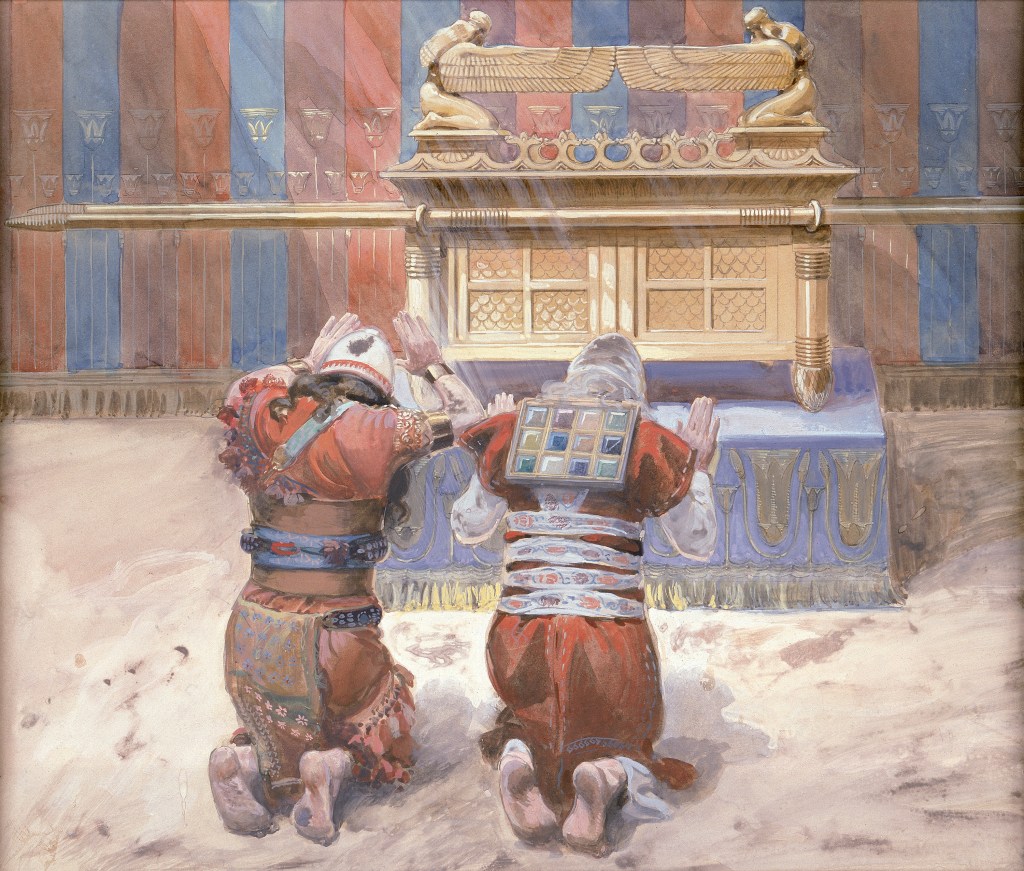
In Exodus 25:19-22, a few chapters later, God commands the Israelites to make images of things in heaven!
“You shall make two cherubim of gold; make them of hammered work at the two ends of the atoning cover.Make one cherub at one end and one cherub at the other end; you shall make the cherubim of one piece with the atoning cover at its two ends.And the cherubim shall have their wings spread upward, covering the atoning cover with their wings and facing one another; the faces of the cherubim are to be turned toward the atoning cover.Then you shall put the atoning cover on top of the ark, and in the ark you shall put the testimony which I will give to you. There I will meet with you; and from above the atoning cover, from between the two cherubim which are upon the ark of the testimony, I will speak to you about every commandment that I will give you for the sons of Israel.” (Exodus 25:19-22)
Cherubim are heavenly creatures! If the Second Commandment is to be interpreted as Protestants claim it is, then here in Exodus 25, God is telling the Israelites to violate the commandment He just gave them! Something else must be going on because the Old Testament Bible is full of God’s commandments to His people to make holy images and even venerate them! I will lay out a bunch of verses here from my NASB Bible.
Exodus 26:1 – God commands them to make holy images on the curtains of the Tabernacle.
Exodus 26:31 – More images for the Tabernacle.
1 Samuel 4:4 – God dwells between the cherubim.
2 Samuel 6:2 – God dwells between the cherubim.
1 Kings 6:23, 24 – Holy images for the Temple.
1 Kings 6:29 – Holy images for the Temple.
1 Kings 6:32 – Holy images for the doors of the Temple.
1 Kings 7:29 – Holy images for the Temple.
1 Kings 7:36 – Holy images for the Temple.
These are a handful of places where God commands his people to make holy images as part of the liturgical worship in the Old Covenant. Again, this is all within the context of the Old Covenant. Did God mess up? No. This comes down to the concept of the image pointing to the prototype. If the prototype is true, holy, and of God, there should be no problem venerating and honoring its image or symbolic representation. The fact that God says no to some images and yes to others, should signal that something other than the Protestant/Evangelical interpretation is going on.
Real Idolatry and the Veneration of Holy Images
What constituted idolatry was not that ANY image is idolatrous but rather what prototype that image pointed to. Does the image direct your heart and worship to the true God and King of Kings or to something else that is lesser? Father Stephen De Young outlines this when he points out the following regarding the form of idol worship that occurred during the time of the early Israelites:
“Because these spirits were, at least currently, without bodies, in order to interact they need to be provided with bodies. This took place in two primary ways. The first was through the crafting of images that the spirit could possess in order to receive worship and offerings. It is for this reason that an image of a god or goddess was the centerpiece of the Greek and Roman temples. The spirit was believed to inhabit the image as a new body. For this reason, it is common in Jewish literature in the Greek language from this period to refer to the idol itself as a daimonion.”1
So, idolatry had an obvious context in the minds of the Israelites of the time. They were not making these images so that a spirit could inhabit it and be worshipped (what worship actually is will be discussed later). Therefore, these images do not violate the commandment that God initially gave in Exodus 20. When the Israelites started to make images for this purpose, God punished them and sent them into exile. Father De Young goes on later in his book stating the following:
“The most common mode of interaction was through the construction of a body for the god by its worshippers, an idol. After the construction of a body, a ritual was undertaken that would ‘open the nostrils’ of the image so that the spirit could enter into it and take up residence. Once the divine spirit was inhabiting the image, the primary task of the priests was to care for the idol by keeping it clean, dressing it, bringing it food and drink, maintaining its home in the temple, and so on.”2
Once again, the Israelites never did this with the images God commanded them to make, and neither do Orthodox Christians with their icons. In fact it is interesting to note that Moses makes an image of the serpent which prefigures Christ (Numbers 21:4-9) and that this image would later be misused and be destroyed by the faithful in 2 Kings 18:4. This illustrates, rather perfectly, what was idol worship and what was proper usage and veneration of images that God commanded the people to make.
The Bible goes further with passages on venerating these images God commanded them for liturgical purposes.
Psalm 132:7 – Commands to worship at the footstool of the mercy seat.
Exodus 3:5 – This shows that material things can become holy, such as the ground around the burning bush.
Joshua 7:6 – Joshua and the elders of Israel bow down before the ark.
1 Samuel 5:4 – The idol of Dagon falls and breaks and prostrates towards the ark.
Luke 10:21, 22 – Christ is the icon (eikōn/εἰκὼν) of the Father, and we worship and venerate him, and all veneration passes from Him to the Father.
Colossians 1:15 – Christ is the image (eikōn/εἰκὼν) of the invisible Father.
How the Incarnation Changes Everything
With all of that said, we need one final piece of the puzzle that shows why Icons are fine and why the incarnation changed everything. Deuteronomy 4:15, 16 says the following:
“So be very careful yourselves, since you did not see any form on the day the Lord spoke to you at Horeb from the midst of the fire, so that you do not act corruptly and make a carved image for yourselves in the form of any figure, a representation of male or female,” (Deuteronomy 4:15, 16, NASB)
The Church Fathers always emphasize that God’s essence is unknowable to us because He is beyond being. We know God through His uncreated energies. Therefore, any image of God the Father they could make would be incorrect. It would not point to the prototype, as we have previously stated.
Therefore, here in Deuteronomy, God warns Moses of this. However, the incarnation of the eternal Logos would change all of this. God would become flesh and take on human form. He would reveal Himself to his people. And if Christ is God incarnate but also Man, then Christ can be depicted. If Christ is the second person of the Holy Trinity, we now have a form! And if any honor given to Christ passes to the Father, then any honor given to the image of Christ passes to Christ as the true prototype.
One thing you come to understand in studying Orthodox Christianity is that the incarnation changed everything. It wasn’t just this juridical cleansing of sins, as many Protestants understand it. It changed creation itself.
- De Young, S. (2021). The Religion of the Apostles: Orthodox Christianity in the First Century. Ancient Faith Publishing.
- Ibid.

 Solas to Saints
Leave a reply to Icons and the Incarnation – Solas to Saints Cancel reply